Indices of Deprivation

The English Indices of Deprivation (IMD) measure relative levels of deprivation in small areas or neighbourhoods. This analysis uses the most recent release (November 2025) for the North East Combined Authority (referred to as the North East in this page) and produced maps and plots that summarise key points. 


Introduction

On 30th October 2025, the government published the latest Indices of Deprivation. The main measure within this update is the Index of Multiple Deprivation (IMD25), which shows how levels of deprivation compare across England. 

England is split into  into 33,755 small neighbourhoods, called Lower Super Output Areas (LSOAs). Each one is given a score and a rank, showing how deprived it is compared with other areas. 

The IMD25 combines information from seven areas, known as domains, of people's lives: income, employment, health, education, housing, crime and the living environment. These are weighted and brought together to give an overall score, their contribution is shown on the bubble plot. You can also look at each domain separately to see what is driving deprivation in a particular area. 


Interpretation

To make the data easier to understand, neighbourhoods are often grouped into deciles. These split all areas in England into ten equal groups based on their level of deprivation.

Decile 1 includes the 10% most deprived areas, while Decile 10 includes the 10% least deprived. This makes it easier to see which places are facing the greatest challenges.

It’s important to note that the IMD shows relative deprivation. This means areas are compared with each other, rather than measured against a fixed standard. As a result, even if all areas improve, their rankings may stay the same. This is why the IMD is best used to understand current patterns of deprivation, rather than changes over time.

In this analysis, we link deprivation rankings with population data. Although neighbourhoods were originally designed to be similar in size, population changes mean this is no longer always the case. By focusing on the number of people living in each level of deprivation – not just the number of areas – we get a clearer picture of how many people are affected.

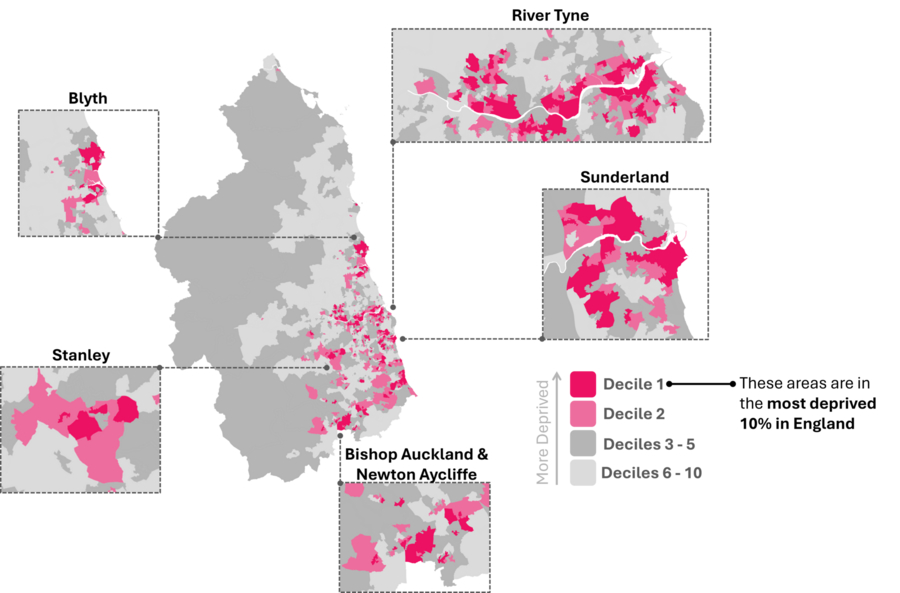
This is important because areas with similar deprivation rankings can have very different population sizes, and maps can sometimes be misleading as neighbourhoods vary greatly in geographic size. For example, a large rural LSOA in Decile 1 might appear to show more deprivation than six small urban LSOAs in the same decile. 


Key IMD Analysis

1,257

LSOAs have been scored and ranked in the North East CA area

1,585

average population in an LSOA in the North East CA area

(mid 2022 estimates)

18%

residents are in the most deprived 10% nationally

(approx 358,000 residents)

66%

of our population live in the most deprived 50%

IMD25 | North East CA area | % population per decile

We can also segment the data up into the 7 Local Authorities (LAs) within the North East. By investigating the percentage of population, we can examine the proportion of population in each decile - particularly as LA populations do vary substancially across the North East

IMD25 | Local Authorities | % population per decile

Next, we can examine the total population within each decile for Local Authority in the North East. This is useful because the Local Authorities differ in population size. The percentage of people in decile 1 in County Durham, for example, is the third lowest in the North East, but the total number of people in decile 1 area is the highest.

In contrast, the plots below give total populations, rather than proportions. This is interesting as the populations do vary quite substantially across LAs within the North East.

➡️ Be careful when viewing these plots as the scales vary!

County Durham

Gateshead

Newcastle

North Tyneside

Northumberland

South Tyneside

Sunderland

North East


Mapping IMD25

IMD map

Source: Office for National Statistics licensed under the Open Government Licence v.3.0
Contains OS data © Crown copyright and database right 2026

This map shows the IMD25 across the North East. LSOAs shaded in pink shades represent lower deciles, meaning they are among the most deprived compared to other LSOAs across England. While grey areas indicate higher deciles, which are less deprived. While mapping IMD helps identify concentrations of deprivation, differences in LSOA size can distort interpretation. Larger rural LSOAs in deciles 3 to 5 dominate the North East map but smaller urban LSOAs in deciles 1 and 2 represent a much higher population but occupy less visual space

For a more accurate understanding, our documentation considers population-weighted analysis and complementary plots alongside maps.


The Domains

The seven domains - Income, Employment, Education, Health, Crime, Housing, and Environment - represent key dimensions of deprivation that influence quality of life and access to opportunities. Each domain captures a different aspect of socio-economic conditions, click on the tabs to find out more about each domain. 


Income

22.5% Contribution

The Income Deprivation Domain measures the proportion of the population experiencing deprivation relating to low income. The definition of low income used includes both those people that are out-of-work, and those that are in work but who have low earnings (and who satisfy the respective means tests).

Employment

22.5% Contribution 

The Employment Deprivation Domain measures the proportion of the working-age population in an area involuntarily excluded from the labour market. This includes people who would like to work but are unable to do so due to unemployment, sickness or disability, or caring responsibilities.

Education, Skills and Training

13.5% Contribution 

The Education, Skills and Training Deprivation Domain measures the lack of attainment and skills in the local population. The indicators fall into two sub-domains: one relating to children and young people and one relating to adult skills.

Health and Disability

13.5% Contribution 

The Health Deprivation and Disability Domain measures the risk of premature death and the impairment of quality of life through poor physical or mental health. The domain measures morbidity, disability and premature mortality but not aspects of behaviour or environment that may be predictive of future health deprivation.

Crime

9.3% Contribution 

The Crime Domain measures the risk of personal and material victimisation at local level. 

Barriers to Housing and Services

9.3% Contribution 

The Barriers to Housing and Services Domain measures the physical and financial accessibility of housing and local services. The indicators fall into two sub-domains: ‘geographical barriers’, which relate to the physical proximity of local services, and ‘wider barriers’ which includes issues relating to access to housing such as affordability.

Living Environment

9.3% Contribution 

The Living Environment Deprivation Domain measures the quality of the local environment. The indicators fall into two sub-domains. The ‘indoors’ living environment measures the quality of the home environment; while the ‘outdoors’ living environment measures quality outside the home in the local neighbourhood.

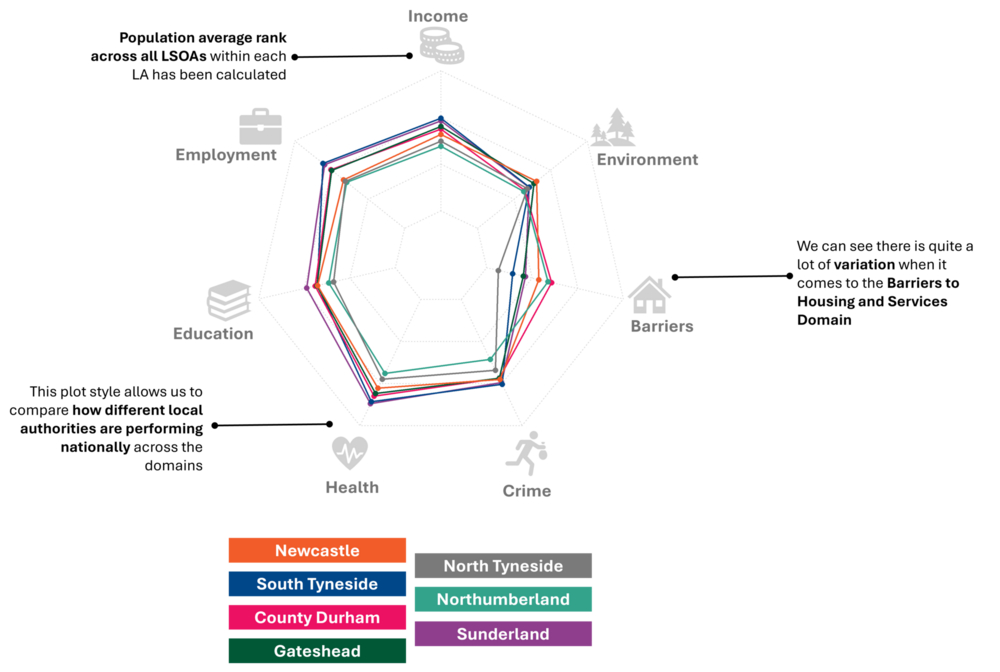
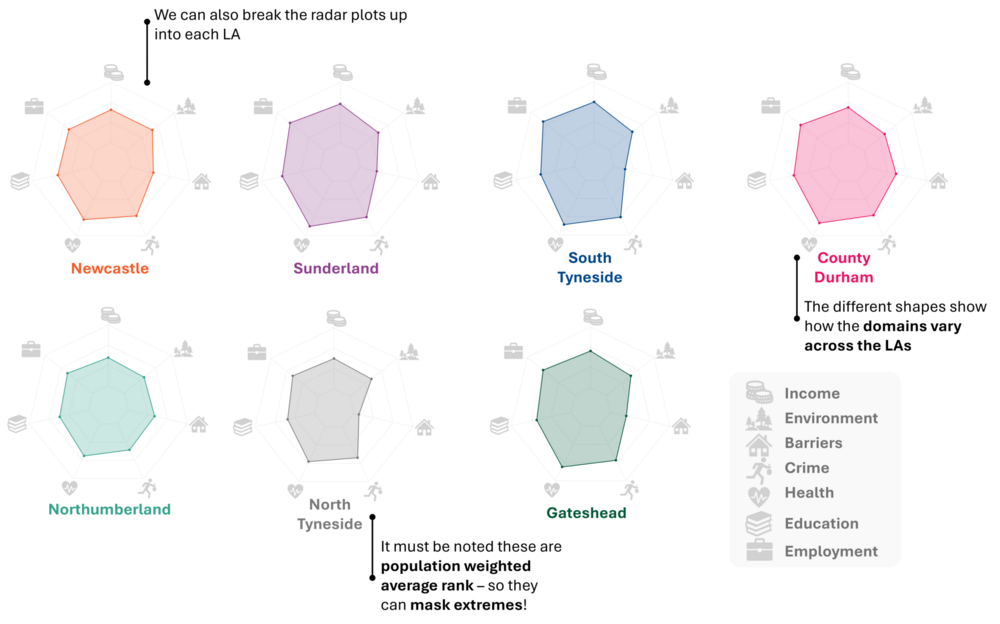
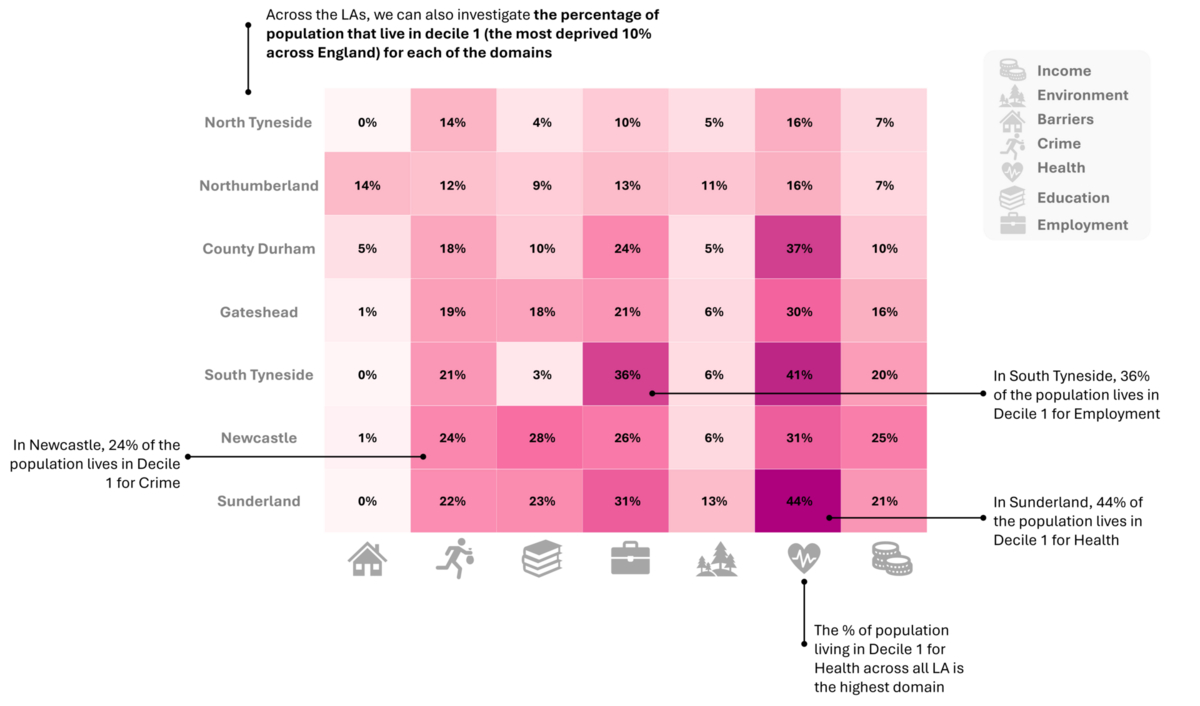
To enable comparison across Local Authorities, we calculated the population-weighted average rank for each domain. This rank has been inverted, so in the radar plots that follow, a larger area indicates a lower average rank and therefore greater relative deprivation in that domain.

full radar


LA split radar plots


heatgrid


Additional Analysis

To complement this work, we have carried out further analysis comparing the North East with other Combined Authorities. This explores how patterns differ between rural and urban areas and examines levels of deprivation using the Income Deprivation Affecting Older People Index (IDOPI) and the Income Deprivation Affecting Children Index (IDACI).

Latest Indices of Deprivation

For more information on the November 2025 release, and the domains, the Ministry of Housing, Communities and Local Government (MHCLG) published a statistical release.