
This page extends that analysis by exploring how the North East compares with other Combined Authorities, examining differences between rural and urban areas and focusing on income‑related deprivation through the Income Deprivation Affecting Older People Index (IDOPI) and the Income Deprivation Affecting Children Index (IDACI).

Patterns of Deprivation by Age
Income Deprivation Affecting Children Index (IDACI) & Income Deprivation Affecting Older People Index (IDOPI)
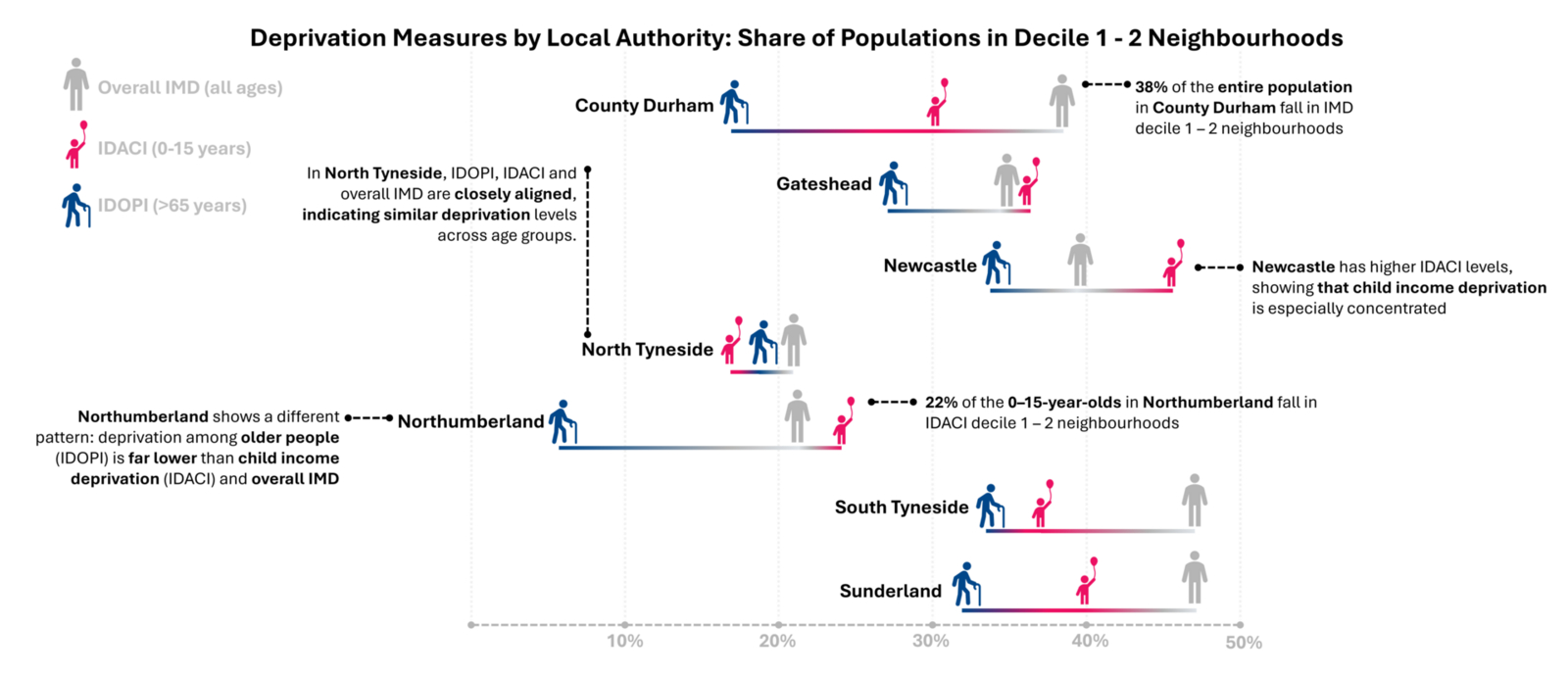
IDACI is a measure within the English Indicies of Deprivation that identifies how income-derpived an area is for children. Each LSOA is allocated a IDACI decile, based on its national ranking. IDACI helps identify where children are most likely to be growing up in financially challenging circumstances.
IDOPI is the equivalent measure for older residents aged 65 and over. It captures the proportion of older people living on low incomes, including those eligible for Pension Credit or other income‑related benefits. Like IDACI, IDOPI uses national deciles from 1 (most deprived) to 10 (least deprived).This helps show where older adults may be at greater risk of financial hardship or social isolation.

Calculations for Local Authorities
To understand how children and older people are distributed across different levels of income deprivation, the IDACI and IDOPI deciles are combined with local population data. For each neighbourhood, we summed how many children aged 0 -15 or older residents aged 65+ live there, and then linked these counts to the deprivation decile assigned to that area.
These population figures were calculated for each local authority to determine the total number of children or older people living in each decile within the area. Percentages were calculated by comparing the number in each decile with the total population of that age group in the local authority
This allows us to understand what proportion of all children in a LA live in the most income‑deprived neighbourhoods (decile 1 and 2), or what proportion of older people live in the least deprived neighbourhoods (decile 10). The result is a clear, population‑weighted picture of deprivation experienced by different age groups.
IDOPI | Local Authorities | % 65 + population per decile
IDACI | Local Authorities | % 0 -15 population per decile
Rural and Urban Comparisons
The geography and landscape across the Mayoral Strategic Authority is highly varied, from the Northumberland wilderness to inner-city Newcastle. It is important to compare IMD across rural and urban areas because North East LSOAs are so varied. The ONS Rural-Urban framework is used here, which classifies LSOAs by assessing types and sizes of settlement and measures of access to services. This ensures that analysis reflects the diversity of settlement types and provides a more accurate understanding of deprivation across different geographic contexts.
This willl enable a comparison between the North East to England, focusing on the distribution of population across IMD deciles for those living in rural settlements only. By splitting the data into rural and urban categories, we will compare the percentage of each that falls into each IMD decile.

Rural Population Distribution
Urban Population Distribution
Examining the distribution of the rural population across deprivation deciles helps to illustrate how the North East compares with England as a whole. Rural areas in the North East are far more concentrated in the most deprived deciles than is seen nationally. Over 26% of the rural population falls within Deciles 1 and 2 (the 20% most deprived areas), compared with just 3.5% across England. Conversely, very few people in the North East live in the least deprived rural areas: only around 5% of the rural population is located in Deciles 9 and 10, highlighting a stark contrast with England, where this figure is closer to 16%.
When looking at the distribution of the urban population across deprivation deciles, the North East more closely mirrors the national picture. This is largely expected, given that the majority of the population in both the North East and England as a whole is concentrated in urban areas.
Comparing to other Combined Authorities
To provide additional context, it is useful to compare the North East with other CA areas across England. This is not intended to rank areas as better or worse performing, but rather to investigate differences in the distribution of deprivation and settlement types. Such comparisons can help identify unique geographic and socio-economic characteristics, highlight variations in rural and urban challenges, and support more informed regional planning and policy development.

Mayoral Strategic Authority Areas | Decile 1 & 2 total population share
For each MSA area, the percentage of all people in that MSA live in rural areas and are in the most deprived IMD deciles (1 and 2) was calculated. This explores how many rural residents are in the most deprived places, compared to the MSA’s total population, showing how much rural deprivation contributes to overall deprivation in each MSA.
The plot below shows the North East MSA area has a very different structure compared to other MSA when it comes to the percentage of popualiton in decile 1 and 2 that reside in rural areas. It is far higher than anywhere else, this pattern indicates that rural deprivation is a significant contributor to overall deprivation in the North East, whereas in most other areas, deprivation is primarily urban.
Mayoral Strategic Authority Area | Decile 1 & 2 rural population share
Change Over Time
The IMD was last published in 2019, so the 2025 release provides the first opportunity in six years to examine how areas have moved within the deprivation rankings. However, IMD is designed as a snapshot, and changes should be interpreted cautiously as they reflect relative position rather than absolute change.
This analysis found that in the North East, 53.7% of LSOAs remained in the same IMD decile group between 2019 and 2025, while 46.3% changed. This is slightly less change than the England average (51% unchanged), suggesting the North East appears minorly less volatile overall.
However, interpreting this change is complex. IMD measures relative deprivation, not absolute change. For example, an LSOA moving from the most deprived 20% in 2019 to the most deprived 10% in 2025 indicates a relative worsening compared to other areas, but this may reflect changes in other places or updates to indicators rather than real local decline.
Looking at decile shifts, most changes are by one decile (e.g., from decile 3 to 2), but some areas moved two or more deciles. These shifts can signal significant relative movement, yet they should be treated cautiously because:
- IMD is a snapshot, not a trend measure.
- Rankings show position relative to all areas, not actual deprivation levels
- Methodology and data updates between versions can influence results.
While decile movement gives a sense of relative change, it does not necessarily mean conditions improved or worsened in absolute terms.

Introducing the Index of Multiple Deprivation
Learn more about how the Index of Multiple Deprivation (IMD) is constructed, the domains that underpin it, and how patterns of deprivation vary across the North East.